

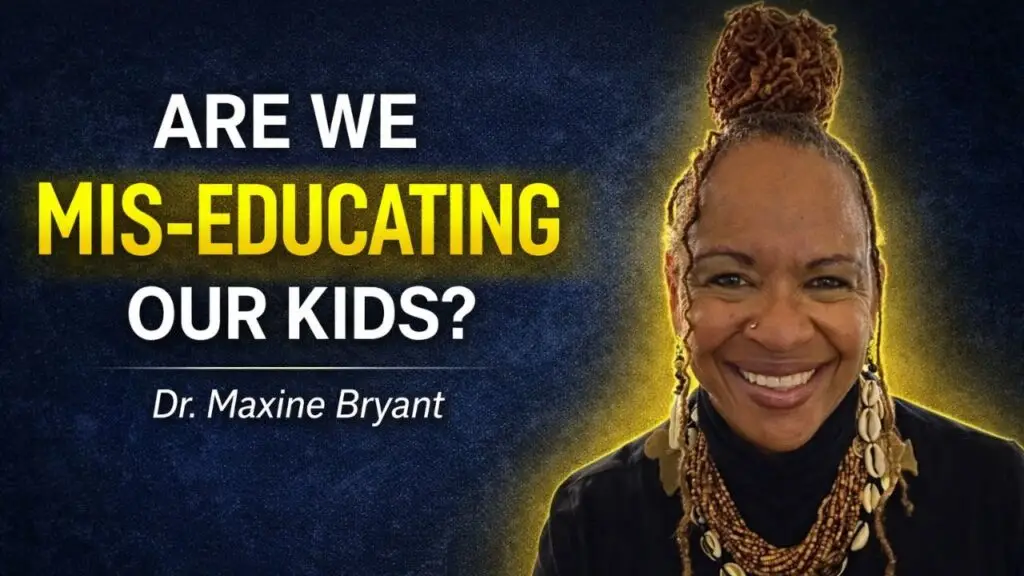
When I sat down with Dr. Maxine Bryant for this week’s conversation, I already felt a little intimidated. Not because she was difficult — she was warm and generous from the first moment. But because her knowledge of Black history in education is deep. She’s an award winning journalist who is rooted in decades of study, research and lived commitment to this work. And I remember thinking somewhere in the middle of our conversation — I should take one of her classes. Not as a journalist preparing for an interview but as a student who still has things to learn about my own history.
That feeling matters because it is exactly the feeling Dr. Bryant wants people to have when connecting to her work. She doesn’t want people ashamed about what they don’t know, but to have genuine curiosity — whether that’s through her classes, her writing or her Black history board game.
I first encountered Dr. Bryant virtually through a program called Speak Sell Shine — a community for Black entrepreneurs who want to build speaking careers. She was presenting about her Black history board game and I remember feeling something I don’t always feel in those kinds of sessions. I felt like I was looking at someone whose mission rhymed with mine. We are both trying to get history into rooms where it hasn’t been before. We are just using different tools to do it.
That feeling is what brought her onto The Color Between the Lines. And what she shared did not disappoint.
The African Proverb Behind This Black History Board Game
Dr. Bryant anchors everything she does in a single African proverb:
“Until the lion tells the story, the hunter will always be the hero.”
For Bryant those words are not just poetic, but a diagnosis for generations. African American history has been told from the outside and filtered through perspectives that minimized, erased or reframed the contributions, genius and resilience of Black people.
The griot in West African tradition is the village keeper. It is essentially the living library, the one who holds the community’s stories and ensures they are passed down with accuracy and intention. Bryant positions herself in that role deliberately sharing her knowledge of Black history. And that has lead to the development of a Black history board game.
“What I endeavor to do,” she explained, “is to replace mythology in African American history, replace misinformation, and fill in the gaps with truth for information that’s been eliminated and minimized.”
In a moment when books are being banned, curricula are being revised and historical content is disappearing from government websites, that mission has never felt more urgent.
Why Teaching Black History Accurately Matters More Than Comfort
One of the most powerful things Bryant said brought me straight back to my own kitchen table.
She talked about the real harm of sugarcoating history.
I grew up in a household where truth was non-negotiable. My mother decided early — she was never going to let me feel like she hid things from me. She didn’t hide the painful parts or the complicated parts. Truth, she believed, builds trust. And trust builds everything else.
I carried that into raising my own son. Nicholas is on the Spectrum and euphemisms in the past didn’t work for him. So, when difficult conversations came, and they did, I had to be direct. I had to be almost Scientific, no softening and no comfortable stories in place of real ones.
And our relationship is stronger because of it.
So, when Dr. Bryant said this I felt it land somewhere personal:
“We’re creating more harm when we sugarcoat things for our children instead of being quite truthful with them. Otherwise, we’re miseducating them. And no good comes from that.”
She was talking about Black history education. But she was also talking about every parent, every teacher, every leader who has ever decided that a comfortable version of the truth was kinder than the real one.
It isn’t kinder. It just leaves people unprepared.
Bryant makes this case from her own experience too. A high school counselor once told her she was not college material. It’s a message he delivered, she believes, largely because of the color of her skin. She nearly believed him. It was her mother who pushed her forward. And somewhere along the way Bryant discovered she was smart, capable and full of potential that no one had thought to reflect back to her.
“If our young people were inundated with accurate truth about their heritage,” she said, “they can begin to change their life trajectory.”
That belief is the engine behind everything Griot Speaks does.
Learning Black History Through the Griot Speaks Board Game
Bryant’s most recent innovation is the Griot Speaks board game. It’s an immersive community-centered learning experience built around more than 300 question cards spanning geography, culture, literature, music, historical figures and pivotal events across the African diaspora. It’s not just a simple Black history board game about American history but a comprehensive game including all types of Black history.
Players move through the board by answering questions. A designated griot reads each card and confirms whether answers are correct. The game is designed not just to test knowledge but to spark discussion, correct misinformation and build a shared sense of pride and curiosity.
What Bryant observed during early test sessions was something I recognized immediately when she described it.
She told me about a session where a master-level high school teacher and a previously incarcerated person with a GED ended up at the same table. They didn’t know each other’s backgrounds. They didn’t know each other’s stories. But they were learning the same history, correcting the same myths and getting genuinely excited together.
When she told me that I thought about something we don’t talk about enough.
We all have this in common — that feeling of curiosity followed by pride when we learn something that connects us to a part of ourselves we didn’t know existed. That is empowerment. And when empowerment happens in a group setting it builds something else entirely — connection. The kind we are all hungry for right now.
So much of our lives happen behind screens. So much of our learning is solitary and scrolled. There is something genuinely refreshing about sitting across from another human being, sharing and discovering together that your history is more remarkable than anyone ever told you.
That is what Dr. Bryant built. And it is working.
Who Is Griot Speaks For?
The Black history board game is designed for adults and older teens with families encouraged to adapt it for younger children with parental guidance. Bryant envisions it in colleges and universities, community centers, family reunions and cultural institutions — anywhere that people are ready to learn together and have genuine fun doing it.
Beyond the Black history board game Griot Speaks offers online virtual classes organized into four modules, each consisting of four weeks of guided learning. Bryant also writes under the Griot Speaks brand for the Indianapolis Recorder, one of the longest-running Black newspapers in the United States.
A phone app and electronic version of the game are already in development — with algorithms designed to adapt to each player’s cognitive ability and learning style.
Why This Conversation Matters Right Now
Bryant is not building Griot Speaks in a vacuum. She is building it in a moment when the phrase diversity equity and inclusion has become politically charged, when school boards are debating what children are allowed to learn and when stories are being quietly removed from public record.
Her response is direct.
“You may not like the letters DEI,” she said. “But the fact of the matter is our world is diverse. Our country is diverse. We’re not all one — and there’s no need for us to try to be.”
Black history education is not a political act. It is an accurate one. And accuracy Bryant argues is what prepares all people — regardless of background — to function in the world they are already living in.
I left this conversation the same way I left our first virtual meeting through Speak Sell Shine. I felt humbled, inspired and genuinely curious about what I still have left to learn.
That might be the best thing a conversation can do.
Listen to the Full Conversation
My full conversation with Dr. Maxine Bryant is available now on The Color Between the Lines — on YouTube and wherever you listen to podcasts.
If this resonated with you, you may also enjoy my conversation with South Carolina Congressman James Clyburn. Or read more about African American Civil War hero Robert Smalls.
To learn more about the Griot Speaks board game and Dr. Bryant’s online courses, visit here.