
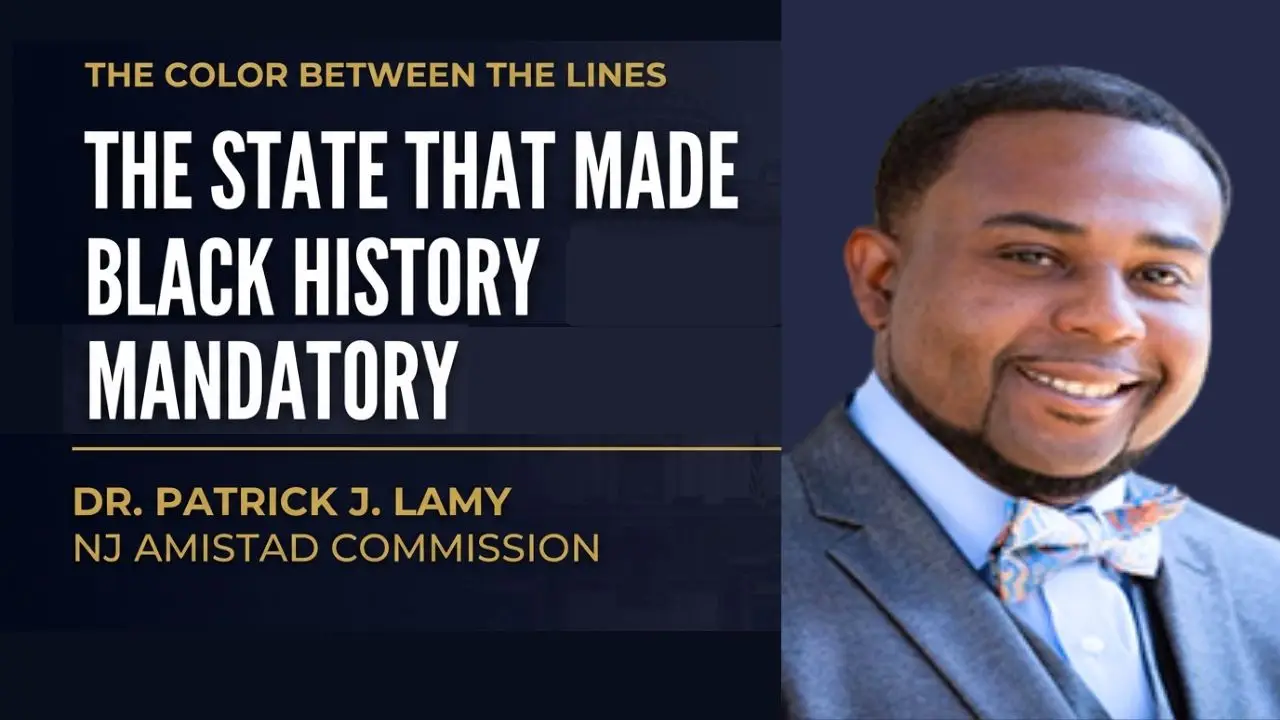
In 2002, New Jersey passed an NJ Black history law that most Americans — including many New Jersey educators — have never heard of. It made the history and contributions of Africans and African Americans mandatory across every subject, every grade level, all year long. Not just in February. All of it.
Dr. Patrick J. Lamy is the Executive Director of the New Jersey Amistad Commission — the body responsible for making that law real across 600 school districts, 100,000 teachers, and 2.4 million students. I sat down with him for an episode of The Color Between the Lines, and I walked away knowing things I did not know before I walked in.
Here are five of them.
The NJ Black History Law Put New Jersey in a Class of Three
Approximately 17 states have some version of a law requiring Black history instruction. But only three — New Jersey, New York, and Illinois — have a formal Amistad Commission with real structure, real staff, and a real mandate. Every other state has guidance. Guidance is not the same as a commission.
Florida had momentum. Dr. Lamy was working with Florida educators as recently as 2022 and 2023. Then Governor DeSantis’s Stop WOKE legislation reversed it. The contrast between what New Jersey has built and what Florida dismantled is the clearest picture I know of what is at stake in this national conversation.
The Law Is Real — But There Is No Enforcement Mechanism
Black history is mandatory in New Jersey classrooms. But when I asked Dr. Lamy what happens when a district doesn’t comply, his answer was more honest than I expected. He used the image of a red light with no police officer on the corner. The law exists. The ticket does not.
What he built instead of enforcement is an incentive model — grants, awards, recognition, and professional development resources designed to make compliance feel like opportunity rather than obligation. He told me plainly: his nature is to be a resource, not an enforcer. I think about that often. Because the opposition is not operating with that restraint.
360 Educators Just Registered for One Program — and That Number Matters
The 2026 Amistad Summer Institute at Kean University has 360 registered educators. Until 2023, the Commission had never exceeded 100 at a single event. That is more than triple the previous record.
I want to be clear about what that number represents. Those educators are not all Black. They cannot be — Black educators are not a majority in the teaching workforce. That registration list is full of teachers of every background who have decided that knowing the full history of this country makes them better at their jobs. Not every educator has accepted the narrative that this work is over. Three hundred and sixty names say so.
The 2026 Summer Institute is free — registration, housing, meals, and resources. Virtual attendance is still open through June 15, 2026. Register at njamistad.gov.
Black Male Teachers Are 1.3% of the U.S. Teaching Workforce
I knew this statistic before I sat down with Dr. Lamy. I knew it the way you know something you have read. But hearing him say it — and then sitting with my own education — made it personal.
I never had a Black male teacher. Not in elementary school, not in high school, not in college. I had Black men who taught me in church settings — Sunday school, Bible study and ministry. Having a Black man lead a conversation was not new to me. But in a formal classroom? Never.
I think about what that absence costs. Not just for Black boys who need to see themselves reflected in academic authority. But for every child — of every background — who grows up without that image. The assumptions people carry about Black men are shaped in part by what they never see. A Black male teacher in a classroom changes that. For every student in the room.
The Most Powerful Argument for Teaching Black History Comes from Students
Dr. Lamy is building a student advisory council for the Commission’s commissioners. He is hosting roundtables where students speak directly to educators. And when I asked him why, he said something I have not stopped thinking about.
That answer comes from the student. Not from me.
Students are telling their teachers: when I learn about myself, my history, how the people who look like me contributed to building this country, I feel a certain kind of way. That is not a policy argument. It is not a legislative brief. It is a child telling an adult what it feels like to finally be seen in a curriculum.
No commission can make that argument. Only a student can.
🎓 Are you a New Jersey educator? Register for the 2026 Amistad Summer Institute — free, virtual attendance available — at njamistad.gov. Deadline: June 15, 2026.
🎧 Listen to the full episode of The Color Between the Lines on YouTube and wherever you get your podcasts.
📌 Free educator discussion guides available at substack.com/@iamestherdillard
🛒 Educator bundles at etsy.com/shop/ColorBtwLinesMarket
Your story matters.
— Esther Dillard