
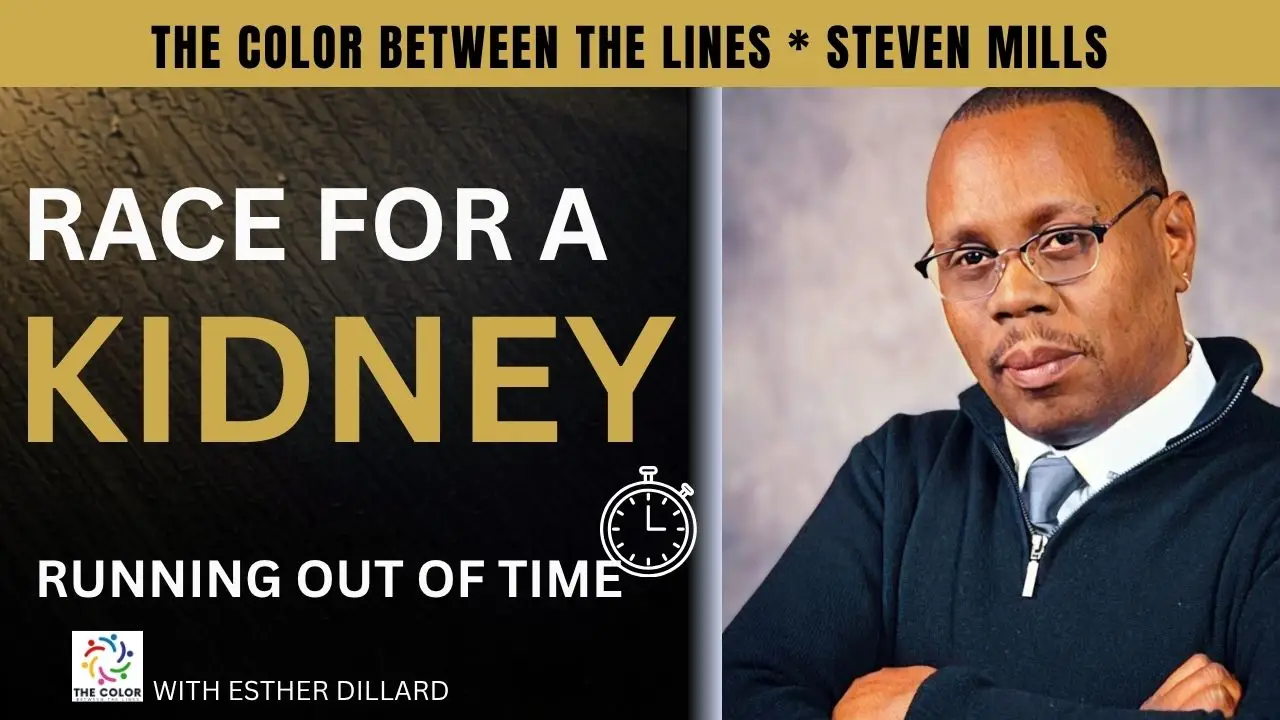
Pastor Steven Mills has already survived two cancers. The treatments that saved his life left him in complete kidney failure, and now he’s racing to find a living donor before time runs out. His fight also points to a wider problem: kidney transplant wait times for Black patients are longer than for white patients, often by a year or more. I sat down with Pastor Mills, senior pastor of First Baptist Church in Garden City, Kansas, to talk about survival, faith, and what it means to keep showing up for your family when your body will not cooperate.
Two Cancers, Then Kidney Failure
Mills was diagnosed with stage 3B Hodgkin’s lymphoma in 2013. The cancer went into remission, returned seven months later, and finally cleared for good at the end of 2019. Two years after that, doctors found stage two colon cancer and removed two and a half feet of his colon. About six months after that surgery, his kidneys began to fail. The chemotherapy that beat his cancer, combined with a bone marrow transplant, left him in complete kidney failure. He now runs peritoneal dialysis at home, up to five times a day.
“We spent $300,000 out of our pocket. You shouldn’t have to pay to be sick to live.”
Mills told me his retirement savings are gone. Between deductibles, co-pays, and a single medication patch that runs $400, some months cost him $3,000 out of pocket, and he cannot work full time to cover it. “We spent $300,000 out of our pocket,” he said. “You shouldn’t have to pay to be sick to live.”
Why the Wait Is Longer for Black Patients
Mills’s case is complicated by HLA sensitization, a condition that develops when the immune system builds antibodies against foreign tissue after events like a bone marrow transplant, a blood transfusion, or pregnancy. Those antibodies make it harder to find a compatible donor. I asked Dr. Giselle Guerra, medical director of the Living Donor and Robotic Transplant Program at the Miami Transplant Institute, to explain why this hits Black patients especially hard. “Minorities, in particular African Americans, tend to have rare blood types,” she said. “That makes it a little bit more challenging for them to get transplanted quicker.”
“Minorities, in particular African Americans, tend to have rare blood types. That makes it a little bit more challenging for them to get transplanted quicker.”
That gap shows up in the national data. The National Kidney Foundation reports that Black Americans are more than three times as likely as white Americans to experience kidney failure, and Black patients on average wait about a year longer for a kidney transplant. For years, some transplant centers also used a race-adjusted formula to estimate kidney function that made Black patients appear healthier than they were, delaying their entry onto the transplant list. That formula was prohibited in 2022, and thousands of Black patients have since had their wait times corrected.
What Living Donation Actually Costs
One misconception Dr. Guerra wanted to correct: living donors do not pay for the process. The recipient’s insurance covers the donor’s evaluation, testing, and surgery, and programs exist to reimburse lost wages, travel, and dependent care for donors who need it. The cost that devastates families like the Mills family falls on the recipient’s side, in the years of dialysis, medication, and care that come before and after a transplant.
“I need to be there for her high school graduation. I need to be there to walk her down the aisle. I need to be there for grandkids. The only way that’s going to happen is if I find a kidney.”
Mills was direct about what keeps him going. “I need to be there for her high school graduation,” he said. “I need to be there to walk her down the aisle. I need to be there for grandkids. The only way that’s going to happen is if I find a kidney.” His daughter is the reason he keeps searching, keeps doing dialysis, and keeps showing up. He set up a GoFundMe to help cover what insurance does not, and his last word to me was simple: do not wait until this happens to someone in your own family to understand what people like him are carrying.
How to Help
Pastor Mills is on multiple transplant waitlists and looking for a living donor match. Living donor and registry information is available here.
You can also help by supporting his GoFundMe, which covers what insurance doesn’t.
Watch the Full Episode
Further Reading
National Kidney Foundation — Black Kidney Health Matters
UNOS — Waiting Time Adjustment for Kidney Candidates Affected by Race-Based Calculation
HRSA / OrganDonor.gov — Living Organ Donation
You can find more inspiring stories like this one on this website, including Kalynne Wilson’s story on living with sickle cell.
Your story matters. — Esther Dillard