

When the safety net has holes, entire families fall through — and the Black experience of homelessness in America is far closer to home than most of us want to admit.
That is the driving question behind my new three-part documentary podcast series, Unhoused and Unheard: The Black Experience of Homelessness, now available on The Color Between the Lines. It is a series I did not set out to make because it was timely or trending. I made it because this issue is personal — and because the people living it deserve more than silence.
The Face of Homelessness Is Not What You Think
It is the face of a 20-year-old college student working two minimum-wage jobs who aged out of foster care and had nowhere to turn. It is the face of a 68-year-old man who spent decades building a career, lost everything during a pandemic, and went to work every single day while sleeping outside at night. And it is the face of a mother of six who packed up her children and crossed state lines looking for help, because staying meant losing everything.
These are not edge cases. These are the stories at the heart of this series. And they are stories that are playing out in families and communities across this country right now.
Why This Is Personal
I did not come to this subject as a detached journalist. Homelessness is not abstract to me. It is something I have watched touch people I love — quietly, painfully, and in ways that most people on the outside never see.
Someone close to me has been navigating housing instability while raising children and trying to find steady work. Watching that struggle from a distance has been one of the hardest things I have experienced as a family member. Right now, the system that is supposed to help has gaps so wide that entire families fall through them and disappear.
Imagine paying $75 or more a day just to keep a roof over your children’s heads because permanent housing is unavailable or inaccessible. Or perhaps you just finally land a job after months of searching, only to discover that earning income can actually disqualify you from the very assistance you need to become stable. Imagine doing everything right — working, applying, waiting — and still having nowhere to go.
That is the reality for far too many Black families in America right now.
The Numbers Tell a Story Too
According to Donald Whitehead, Executive Director of the National Coalition for the Homeless, African Americans make up 13 percent of the general population but 40 percent of the homeless population. That gap is not an accident. It is the result of decades of structural inequality in housing, employment, and a social safety net that was never fully designed to serve Black Americans equitably.
According to HUD’s 2024 Annual Homelessness Assessment Report, homelessness in America increased by 18 percent in a single year — reaching its highest level since federal tracking began. Families with children saw the steepest rise — up 39 percent from the previous year.
And according to the National Alliance to End Homelessness, people aged 50 and older are now the fastest-growing group experiencing homelessness in America, with numbers projected to triple by 2030.
These are not abstractions. These are people. And their stories deserve to be told.
What I Learned From Making This Series
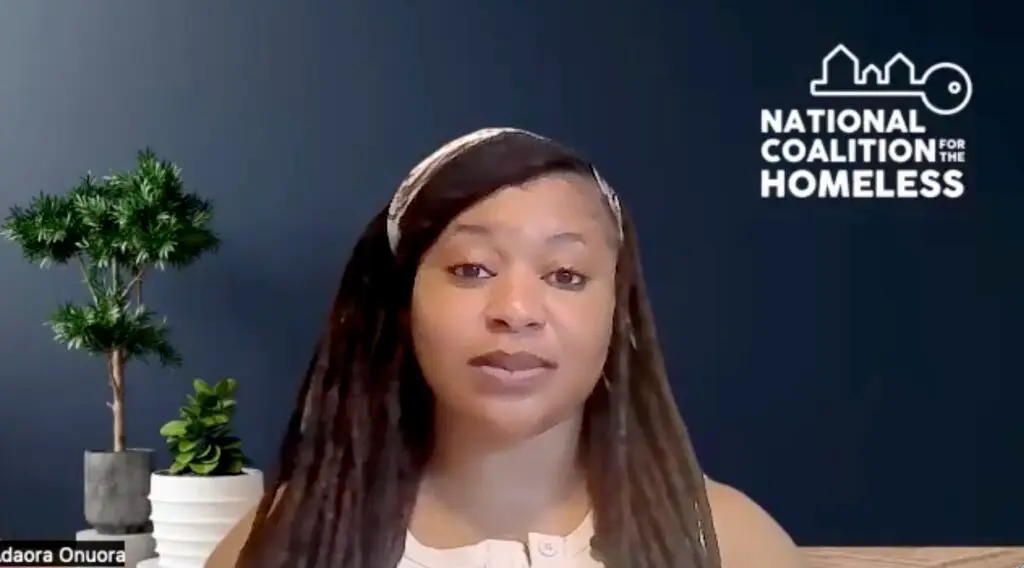
What I learned from conversations with Whitehead and with Adaora Onuora — a woman who survived housing instability after aging out of foster care and now works with the National Coalition for the Homeless — is that the people doing the most important work in this space are not giving up. They show up every day with resources, with compassion, and with an unwillingness to let the most vulnerable people in our country be forgotten.
Not everyone experiencing homelessness is a scammer or struggling with addiction. Not everyone fits the stereotype that our culture has decided is the face of this crisis. Some of them are our family members. Many of them are working two jobs. Andsome of them are sitting next to us on the train and we have no idea.
That is why I made this series. Not to exploit anyone’s pain. But to shine a light on the truth — with care, dignity, and the journalistic standard that these stories deserve.
Watch or Listen Now
▶️
Part One of Unhoused and Unheard: The Black Experience of Homelessness is available now on The Color Between the Lines — on the ALIVE Podcast Network, iHeartRadio, Apple Podcasts, Spotify, YouTube, and wherever you listen to podcasts.
If this series moves you, please share it.
And if you want to get involved or find resources in your community, visit nationalhomeless.org.
These stories matter. And so do the people living them.
— Esther Dillard Host, The Color Between the Lines