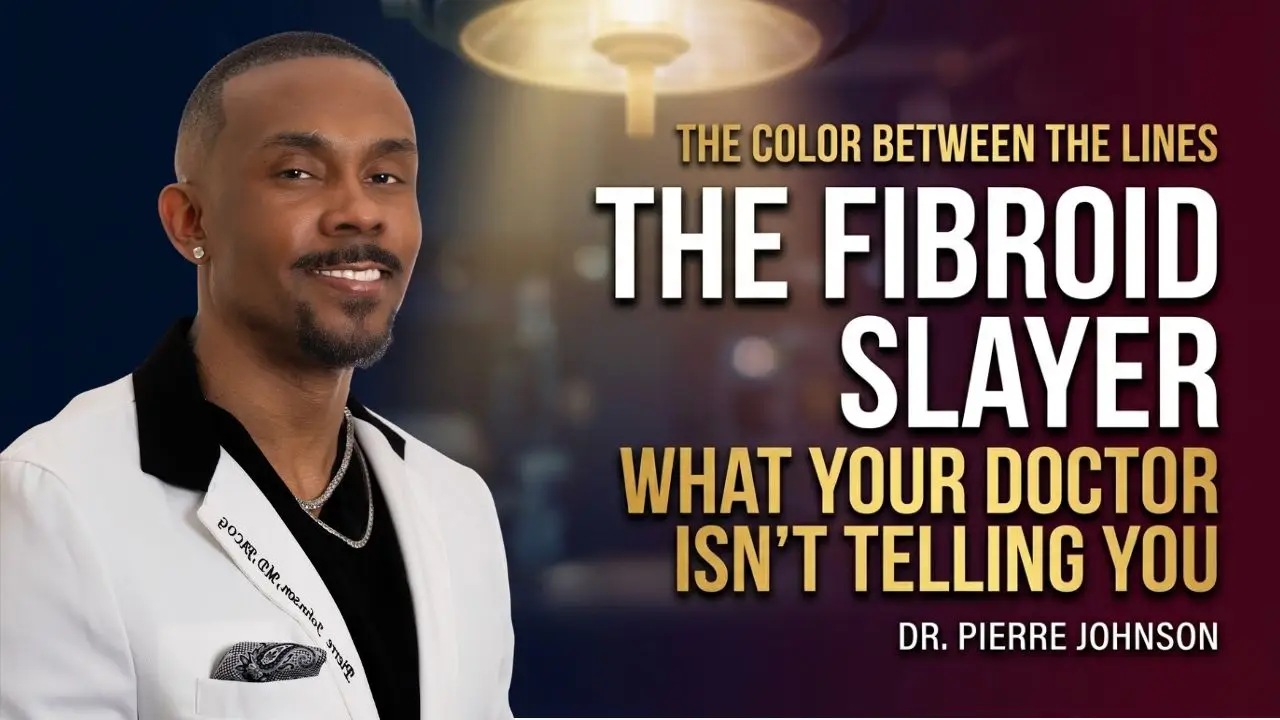
What the Fibroid Slayer Told Me That Changed Everything
A conversation with Dr. Pierre Johnson — and the moment I had to be honest about my own choices
Black women with fibroids are diagnosed at two to three times the rate of white women. Their disease is more advanced by the time they get care. And when they walk into a doctor’s office looking for answers, they are historically less likely to be believed — and less likely to be offered real options. I have covered these kinds of stories before as a journalist.
But this week, listening to Dr. Pierre Johnson — the board-certified OB-GYN known as The Fibroid Slayer — I was not just a journalist. I was a patient. And what he said made me examine my own choices in a way I did not expect.
The Doctor Who Said Yes When Everyone Said No
Dr. Pierre Johnson grew up on the south side of Chicago. He holds a documented 0% repeat surgery rate at a time when the national average for fibroid recurrence after surgery is 40%. And he has built his career on doing the thing the medical system too often refuses to do for Black women — listening, and then acting.
His most recent viral case tells you everything you need to know about who he is. A pregnant patient came to him with 27 pounds of fibroids pressing on her uterus and organs. Other doctors had told her to terminate the pregnancy. The hospital where he planned to perform the surgery tried to cancel it. Dr. Johnson fought the institution. He removed the fibroids. The pregnancy was saved. Her uterus was preserved.
That woman found him because she refused to stop looking for a doctor who would say yes. Her story is not an exception. According to Dr. Johnson, it is a pattern — one that shows up in maternity mortality rates, in misdiagnosis rates, and in the operating room decisions made — or not made — for Black women every single day.
Why Fibroids and Black Women: The Answer Is Not Just Biology
I asked Dr. Johnson the question I think most people assume has a simple biological answer — why are Black women diagnosed with fibroids at such dramatically higher rates?
His answer was more honest than I expected from a physician.
According to Johnson, it is not that Black women have more disease. They have more advanced disease — because they start behind. Things including: chronic stress from microaggressions, food deserts and a medical system that Black communities have every reason not to trust. The mistrust was earned through centuries of documented harm. The add delayed family formation driven by economic inequality, which means that by the time many Black women are ready to start their families, fibroids that went undetected for years have had time to grow.
“When you add all of those things together, you have a woman who shows up to the doctor’s office already behind.” — Dr. Pierre Johnson
It is not a health story wearing the clothes of a health story. It is an equity story. And Black women are paying for it with their bodies.
The Moment I Had to Be Honest With Myself
When I asked Dr. Johnson about hysterectomies and menopause, he paused my question to correct something I had assumed was common knowledge.
He said the uterus does not produce hormones. The ovaries do. Which means that a hysterectomy with ovary preservation does not cause immediate menopause. The procedure removes the uterus — the bleeding, the pain, the fibroids — but leaves the hormonal system intact. Menopause, he said, is not automatic. It is a choice — or it should be.
I paused for a moment because I made a different choice.
After my own fibroid surgery — after seven years of trying to conceive, a specialist removed 23 fibroids from my uterus. After that I was able to concieve and my son Nicholas was born. I eventually had my uterus and ovaries removed because the fibroids grew back. My doctor gave me the option to keep my ovaries. But there was a risk. No family history of ovarian cancer, but a risk nonetheless. I had already been through so much and I did not want another surgery. I did not want another recovery. So I said take them. And I went straight into menopause. Knowing that it would happen. Choosing it anyway.
My Choice for Menopause was a Reminder.
Was it the right choice? For me, at that moment, with the information I had and the life I had already lived — yes.
But here is what Dr. Johnson reminded me: not everyone has had that conversation. Not everyone knows they have that choice. And that is the problem. Women are walking out of doctor’s offices believing that fibroids equal hysterectomy and hysterectomy equals immediate menopause — end of story — when none of that has to be true.
“You always have options. But they all center around what goals you have.” — Dr. Pierre Johnson
That sentence is the whole episode. Know your goals. Ask for options. And if your doctor is not offering them — find one who will.
The fibroid crisis for Black women is personal for me
Before my son was born, my husband and I tried to have a child for seven years. One doctor told me I might not be getting pregnant because my husband and I were not having enough “deep” sex as he called it. I reported him to the physician who referred him. I found another doctor — a woman, an OB-GYN and fertility specialist in Michigan. She found the fibroids, removed them and saved my uterus.
After that surgery, I became pregnant.
I know what it is like to sit in a waiting room and blame yourself. Leaving a doctor’s office feeling dismissed and unheard and smaller than when you walked in — that feeling is real. And I know what it means — finally — to find the right doctor.
That is what Dr. Pierre Johnson does every single day. And that is why this conversation matters beyond fibroids — it matters for every Black woman who has ever been told her only option is the one the doctor decided on before she sat down.
Watch the Full Conversation
The full episode is now live on The Color Between the Lines on YouTube and all podcast platforms. In it, Dr. Johnson also talks about his Pulse of Perseverance initiative — a mentorship movement designed to change the pipeline for the next generation of Black doctors. Because the crisis he treats in the operating room every day is also a pipeline problem. And he is working on both. If you are a Black woman navigating fibroids right now — this conversation is for you.
RESOURCES FROM THIS EPISODE Watch the full episode: The Color Between the Lines on YouTube Find Dr. Pierre Johnson on Instagram: @doctorp23 Pulse of Perseverance book: link in episode description
If this conversation made you see something differently — share it. Someone in your circle needs to hear it.