
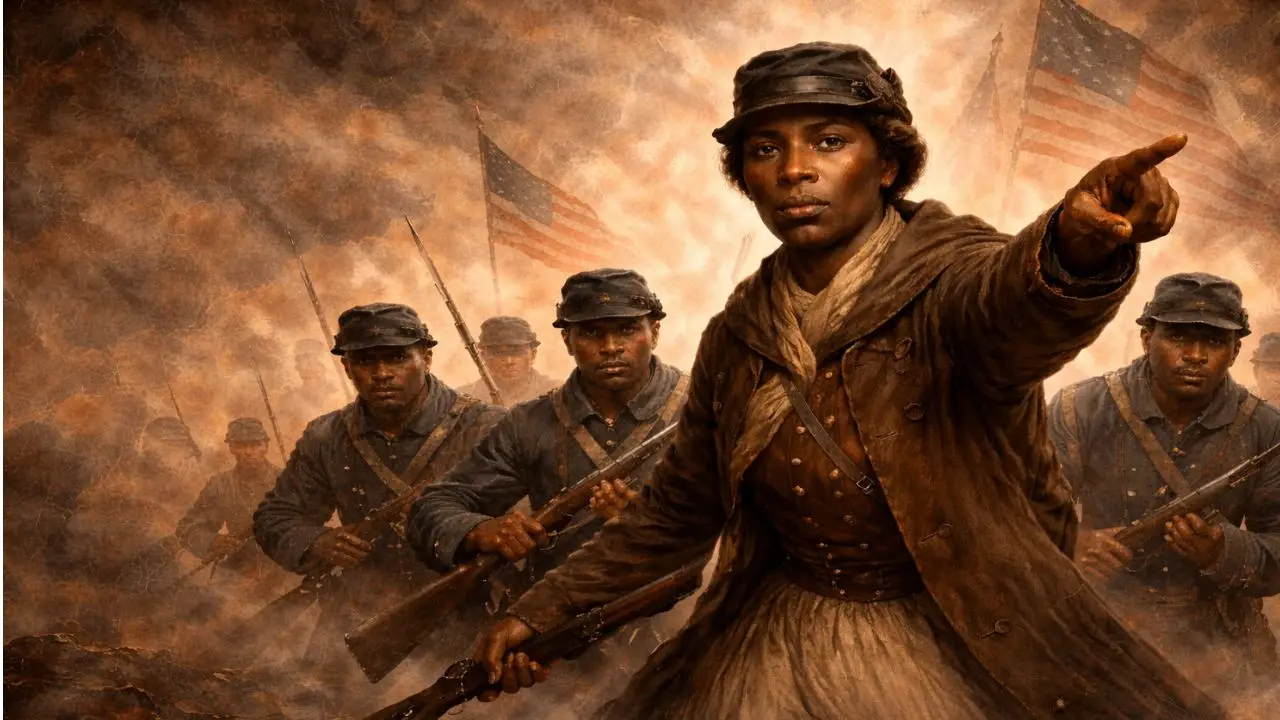
A reflection on journalism, unexpected connections, and how a National Park Service interview led to one of the most meaningful conversations in my ERASED series.
How an Unexpected Interview Led Me to Harriet Tubman’s Descendant
How an unexpected interview led me to Harriet Tubman’s descendant is a reminder that storytelling, and life, often works best when we stay open to the unexpected.
Historians often tell Harriet Tubman’s history through the story of the Underground Railroad, but her Civil War leadership and intelligence work remain far less widely understood.
As a journalist, you sometimes walk into a story with a clear plan. You know what kind of interview you want. You understand the angle. And you know the audience you are trying to reach.
But I have found repeatedly in my life to give every moment that may seem random and unexpected a chance. Because if you become too rigid it can cause you to miss something important.
Recently, while working on my documentary series ERASED, I was reminded of that lesson in a very unexpected way.
When a Story Doesn’t Fit the Original Plan
So, I’m sharing this example of how a story doesn’t fit the original plan.
I was working on the development of my next episode of my series ERASED, notification appeared in my inbox from a representative of the National Park Service. At the time, Washington DC lawmakers were at odds over the Affordable Care Act. And the government was shutdown along with the National Park Service. They pitched me an interview with a representative who could talk about the Harriet Tubman National Historical Park.
The first interview I conducted was excellent. The person I interviewed gave detailed, thoughtful, and incredibly interesting information. The problem wasn’t the interview.
The problem was the fit.
I contribute to a news feature program called The Black Perspective on the Black Information Network, where the goal is to center Black voices and conversations that reflect the lived experiences and viewpoints of the Black community. The interview I had recorded simply didn’t align with that format.
So instead of forcing the interview into a place where it didn’t belong, I used it in a different way—within my news segments for my day job as an anchor for the Black Information Network.
I ran excerpts throughout the week.
It was still valuable journalism.
But it wasn’t the story I thought I was looking for.
Here’s where the story took an unexpected turn.
The Unexpected Connection to Harriet Tubman’s Family
Because I stayed open to the interview—and maintained that professional relationship—the source gave me an unexpected connection to Harriet Tubman’s family. The person I interviewed connected me with Michelle Jones Galvin, the great-great-great grandniece of Harriet Tubman.
Michelle is also the co-author of the book Beyond the Underground: Aunt Harriet, Moses of Her People, which shares Tubman’s story through the lens of family memory and generational storytelling.
And that interview became one of the most powerful parts of the ERASED: The Harriet Tubman Story episode.
The Lesson: Not Every Ingredient Belongs in the Same Meal
I believe in my core that every experience is connected, which often means not every ingredient belongs in the same meal.
And follow me here for a moment.
Sometimes when you are cooking, you have an ingredient that is valuable, interesting, and meaningful—but it simply doesn’t belong in the dish you’re currently preparing.
That doesn’t mean the ingredient is useless.
It simply means you may need to cook a different meal…or hold that until later when the time is right.
In journalism, in storytelling, and in life, we sometimes try to force ideas into spaces where they don’t belong.
But when we allow ourselves to stay open—to pivot, to adjust, to repurpose—something better often emerges.
In my case, the interview that didn’t fit the original format ultimately led me to the voice I needed for a really powerful story.
And that voice helped bring a new perspective to the legacy of Harriet Tubman, whose leadership during the Civil War included work as a nurse, scout, and intelligence operative guiding Union forces.
You can explore more about Harriet Tubman’s life and historical impact through the Library of Congress Harriet Tubman archives.
Trusting the Process in Storytelling
As journalists, creators, and storytellers, we often feel pressure to make everything fit perfectly from the beginning.
But sometimes the most important stories appear after the first plan doesn’t turn out as you expected.
That’s why I try to remember something simple:
Start the work.
Tell the story.
Stay open to what unfolds next.
Often, the story you thought didn’t belong in the first chapter becomes the key that opens the next one.
Frequently Asked Questions About Harriet Tubman’s History
Who was Harriet Tubman?
Harriet Tubman was an abolitionist, Underground Railroad conductor, and Civil War scout and intelligence operative who helped guide Union forces and worked to free enslaved people throughout the United States.
Did Harriet Tubman serve in the Civil War?
Yes. During the Civil War, Harriet Tubman served as a nurse, scout, and spy for Union forces. She also helped plan and guide the Combahee River Raid in South Carolina, which helped liberate more than 700 enslaved people.
Who is Harriet Tubman’s descendant Michelle Jones Galvin?
Michelle Jones Galvin is the great-great-great grandniece of Harriet Tubman and co-author of the book Beyond the Underground: Aunt Harriet, Moses of Her People. She works to preserve and share her ancestor’s legacy.
What is ERASED: The Harriet Tubman Story?
ERASED: The Harriet Tubman Story is a documentary episode in the ERASED series created by journalist Esther Dillard. The film explores Tubman’s Civil War leadership and includes an interview with her descendant Michelle Jones Galvin.
If these types of conversations interest you, please support my work with a free subscription and/or a small monetary contribution.
I also love feedback. Is there a historical figure you believe has not been given respect in the past when they have contributed so much to our world today? Feel free to drop a comment.
#HarrietTubman
#BlackHistory
#Storytelling
#Journalism