
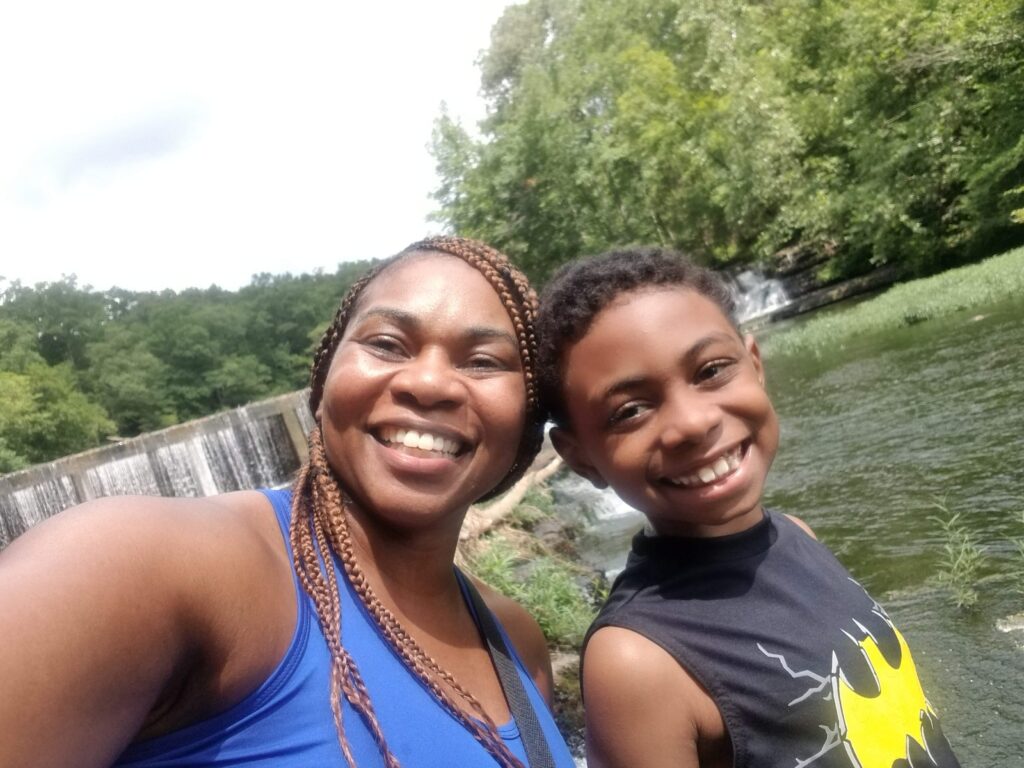
The call came the day before Thanksgiving. A nurse told Dr. Lametra Scott, a pharmacist, that her newborn didn’t have sickle cell disease. He had only the trait, the same as her and her husband. It was welcome news, and for about three months, it held. Then a caseworker from the health department called with different news. The lab had misread the newborn screening. Rickey had sickle cell disease, type SS, and needed to see a hematologist right away — a diagnosis that would eventually lead him to a groundbreaking sickle cell gene therapy.
Rickey is now one of the first commercial patients to receive Casgevy, the first CRISPR gene-editing therapy the FDA has approved. He received it at TriStar Centennial Children’s Hospital in Nashville. His story, and his mother’s, is the subject of this week’s episode of The Color Between the Lines. Together they trace the arc of a disease. In just a few years, it has gone from lifelong management to a real curative option.
A Diagnosis That Felt Like a Stopwatch
Sickle cell disease turns round, flexible red blood cells into rigid, crescent-shaped ones. These cells clog blood vessels, blocking blood flow and triggering what doctors call a pain crisis. In children, one of the most dangerous complications is acute chest syndrome — the leading cause of death before age five. It’s what sent Rickey to the hospital at age three after what looked like a routine fever. A chest X-ray showed infiltrates in his lungs. His hemoglobin dropped below his baseline. He needed a blood transfusion.
“It felt like somebody had knocked the wind out of you, because at that moment it’s almost as if there was a stopwatch for your child’s life.”
As Rickey got older, the crises compounded — more pain episodes, more missed school, a rising risk of stroke and organ damage. Scott and her husband first looked at a bone marrow transplant, the only curative option before gene therapy existed. But neither was a close enough match to donate safely. Roughly 80 percent of people with sickle cell disease don’t have a matched sibling either. Gene therapy, limited to patients 12 and older, became the plan the moment Rickey turned 13.
How This Sickle Cell Gene Therapy Actually Works
The therapy Rickey received is Casgevy (exagamglogene autotemcel, or exa-cel), the first CRISPR-based sickle cell gene therapy ever approved by the FDA. Approval expanded on July 1, 2026 to children as young as two — a decision built on trial results Dr. Haydar Frangoul, director of pediatric hematology, oncology, and stem cell transplant at TriStar Centennial Children’s Hospital, called “phenomenal”: 100 percent of the children treated under 12 in that trial had zero symptoms related to the disease afterward. He explained the science in plain terms on the show.
“We take the stem cells out, gene edit them using this CRISPR technology, telling the cells to make high levels of fetal hemoglobin, and put them back into the patient. Those new cells start making high levels of fetal hemoglobin — more than 40 percent — so the individual becomes basically a person with sickle cell trait.”
It’s a one-time treatment: doctors extract a patient’s own cells, edit them, and return them — no donor match, no anti-rejection drugs, no risk of graft rejection. Frangoul pointed to Victoria Gray, the first person to receive the therapy, in a 2019 trial at his hospital: before treatment, she went to the hospital seven or eight times a year. Years later, she has had zero visits.
The Sign the Sickle Cell Gene Therapy Was Working
People with sickle cell disease often develop a yellow-beige tint in the whites of their eyes — a marker of the rapid red blood cell breakdown that floods the bloodstream with bilirubin. Scott had watched for that tint in Rickey’s eyes his entire life; it was often the first sign a crisis was coming. Weeks after his treatment, before any lab result confirmed it had worked, she looked at her son and saw something she hadn’t seen in years.
“One morning I got up, and my husband was sitting next to me, and I just nudged him on the arm and I was like, ‘Look, look at his eyes.’ His eyes were white. The whites of his eyes were actually white, and we hadn’t seen that in years.”
Scott’s advice to other parents navigating a system that doesn’t always move fast enough is direct: keep pushing. “You have to have some gusto within you to keep pushing forward when you run into roadblocks,” she said.
Is Rickey Cured?
That’s the question at the center of this story, and it’s the one I put directly to Dr. Frangoul’s team after our interviews. Here is their on-the-record response:
“It is accurate to describe Ricky’s treatment as curative. The therapy is intended to cure sickle cell disease, and available data show the gene editing persists and protects patients from complications. Ricky will continue to be followed long term to ensure the treatment continues to be effective.”
Curative is the accurate word — it’s not a claim that the story is finished. At the time of our interviews, Rickey was roughly two months past treatment, short of the 100-day mark where his care team fully assesses how much of his blood the edited cells are now making. Doctors have already confirmed the new cells engrafted, and the disease’s daily symptoms are gone. What’s still ahead: years of follow-up to confirm it stays that way.
Watch the Full Episode
Watch and Learn More
Vertex Pharmaceuticals — FDA approval expanding CASGEVY to patients ages 2 and older: https://news.vrtx.com/news-releases/news-release-details/vertex-announces-us-fda-approval-expanded-use-casgevyr-treatment
TriStar Health — TriStar Centennial Children’s Hospital paves way for a new sickle cell disease treatment article is here.
CDC — Sickle Cell Disease data and overview HERE.
Related reading: “Living With Sickle Cell: What Kalynne Wilson Wants You to Understand“.
Your story matters. — Esther Dillard