
James Clyburn on the 1876 Election and Why One Vote Still Matters
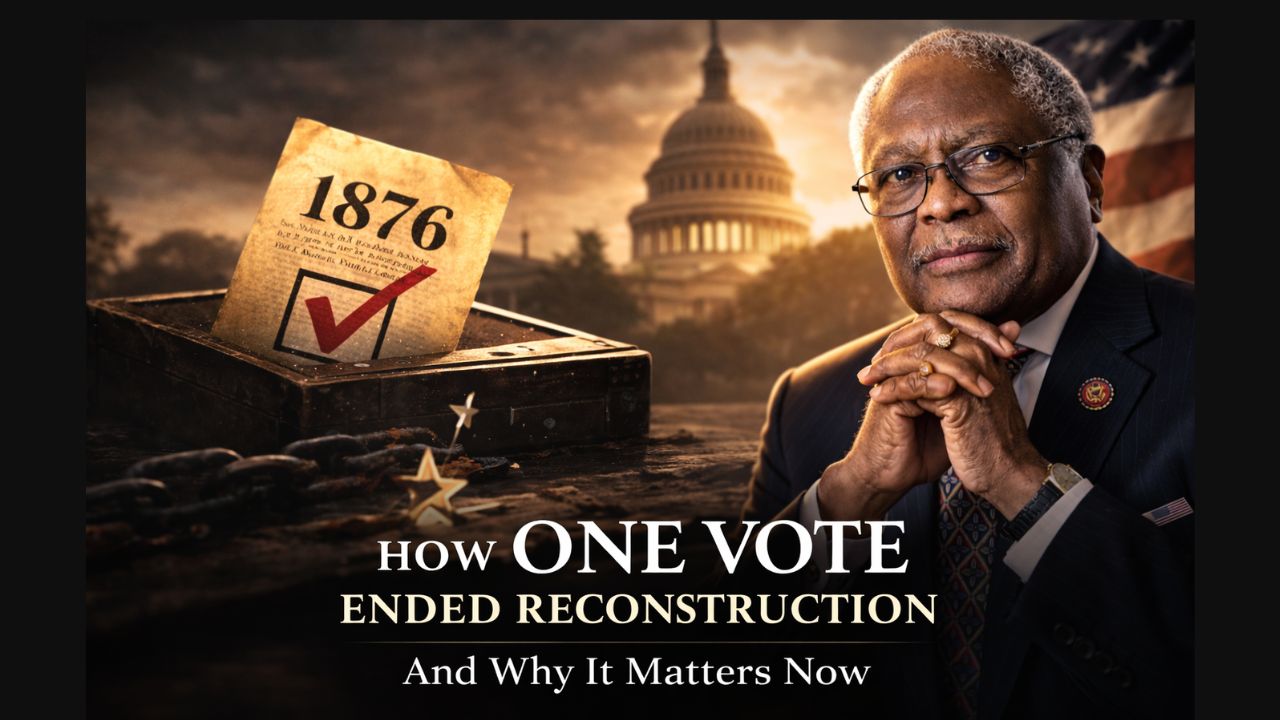
When I was told I had the opportunity to speak to South Carolina Congressman James Clyburn about Reconstruction and how it ended, I was really jazzed. It’s not because he’s a politician or that’s he’s got decades of political clout, but because I wanted to understand whether today’s political confusion connects directly to how Reconstruction ended after the Civil War. And boy did he deliver.
In our brief conversation about his newly released book: The First Eight: A Personal History of the Pioneering Black Congressmen Who Shaped a Nation, three things stood out to me.
1. Schools often don’t fully teach the Reconstruction era
At one point, Congressman Clyburn said:
“If people really knew the story of Reconstruction — how it came about and, most importantly, how it came to an end…”
He said often history educators focus on dates and not events. They memorize 1865. They memorize 1877. But they are not taught what actually happened in between which includes: the policies, the votes and the compromises.
The gap between the dash really matters a lot.
Because if you don’t understand how Reconstruction ended, you can’t fully understand how Jim Crow began. And if you don’t understand that progression, today’s debates about voting rights, representation, and even reparations can feel disconnected from history.
He made is clear that Reconstruction wasn’t ancient history. It was an important pivot point that set up all the debate during the civil rights era and what we’re grappling with today.
2. Three Single Votes Reshaped Black Political Power
Clyburn said:
“The three most consequential things that happened to Black people in this country were each decided by a single vote.”
One vote decided three important things for Black Americans after the civil war that created many of the political fights that have happened for more than 100 years. Freedoms and federal protections shifted during the Reconstruction era. It’s one of the reasons why we are even today talking about reparations for African Americans.
He walked through the impeachment of Andrew Johnson.
He explained the 1876 election.
He described how, by an 8–7 commission vote, Reconstruction effectively ended.
Those three events led to nearly 100 years of Jim Crow laws. And the promises of land and freedoms made to Black men who fought for the Union during the Civil War were abandoned. Reparations were supposed to happen back then but they didn’t.
It made me truly sit back and reexamine things I’ve heard for year. And that’s especially when I consider the phrase “your vote doesn’t matter.”
Because historically, one vote has mattered — profoundly.
3. Your One Vote Is Not Symbolic
Clyburn put it plainly: “If people really realized this, they would never say again, ‘My one vote won’t count.’”
And he’s not just spouting political talking points. Historically, it really does.
If one vote helped end Reconstruction — if one vote helped determine the direction of Black political power for generations — then civic participation today is not abstract.
He connected that history to current conversations about voting rights protections and the Voting Rights Act. And he made it clear why so many leaders argue that access to the ballot remains one of the most consequential issues of our time.
The Robert Smalls Connection
Finally, I really enjoyed him expounding more on the significance of Robert Smalls on history and why he was so important.
Smalls escaped slavery, commandeered a Confederate ship, delivered it to Union forces, and later served in Congress during Reconstruction.
Smalls was one of the influential leaders who convinced hundreds of Black men to join the Civil War and convinced white leadership at the time that Black men could do the job. His heroism paved the way.
His story also reminds us that Reconstruction was not just a political experiment — it was a moment of real Black political leadership and possibility.
And when that era ended, something was lost.
For anyone asking what ended Reconstruction and why that period still shapes modern voting rights debates, this conversation offers clarity.
You can hear more of my full conversation with Congressman James Clyburn on The Color Between the Lines.
Please support my work by subscribing to the channel.